
SEO vs Paid Advertising: Which Is Better for Your Business?
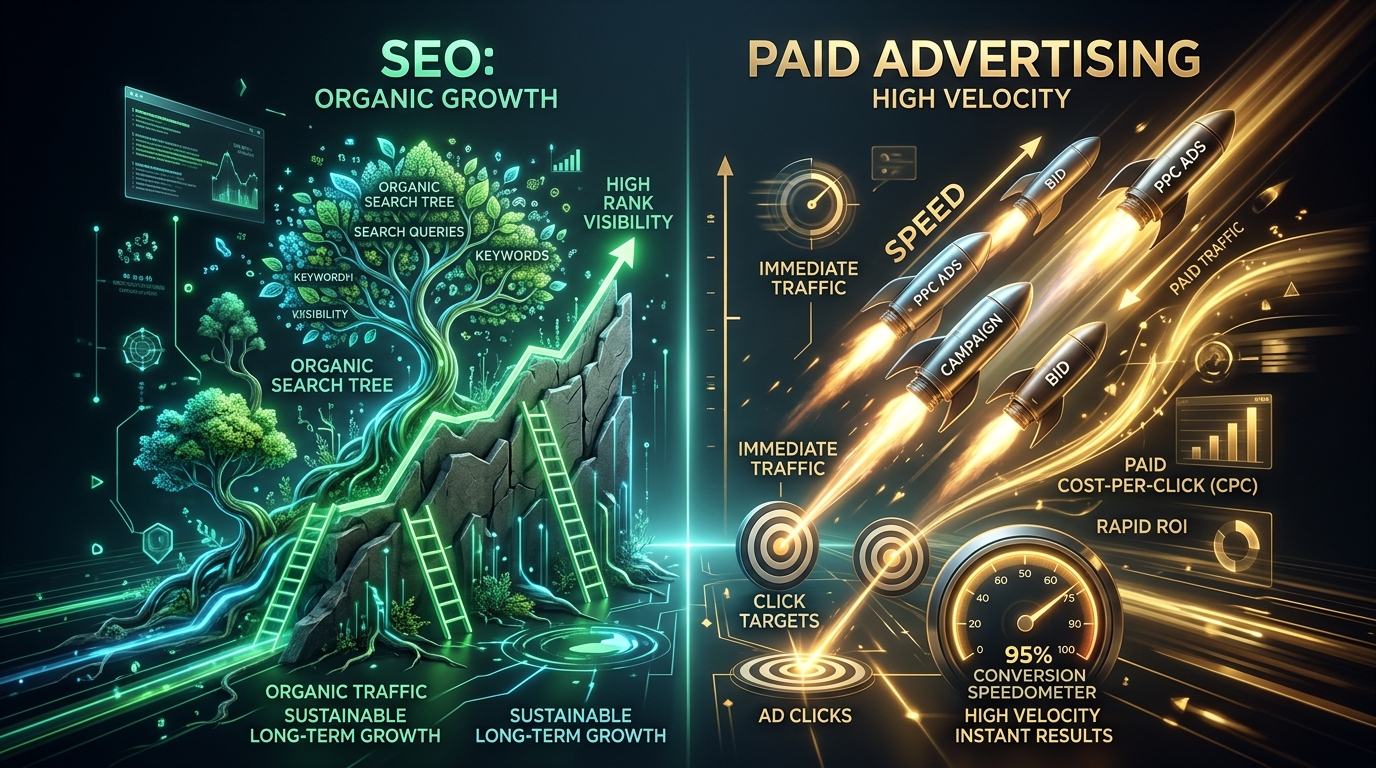
One of the most common questions business owners ask when starting digital marketing is: “Should I invest in SEO or paid advertising?” The answer is not the same for every business.
SEO and paid advertising are two distinct strategies that can work independently, but they become significantly more powerful when orchestrated together.
SEO focuses on earning long-term visibility in organic search results, while paid advertising allows businesses to pay for targeted placement on search engines, social media networks, and video platforms. Understanding their fundamental differences will help you allocate your growth budget with confidence.
What Is SEO?
Search Engine Optimization (SEO) is the process of enhancing a website so search engines recognize its relevance and authority, ranking it prominently for high-value user searches.
For example, if someone searches “best digital marketing company in Chennai”, Google displays organic listings beneath the sponsored ads. Businesses that rank on page one receive ongoing visitor traffic without paying Google for each click.
Enterprise SEO encompasses:
- Comprehensive keyword research & search intent mapping
- Technical site architecture, schema markup, and Core Web Vitals optimization
- Authoritative, high-value on-page content creation
- Strategic internal linking structures
- High-quality editorial backlink acquisition and digital PR
- Local Google Business Profile and regional citation building
What Is Paid Advertising (PPC)?
Paid advertising involves bidding on ad auctions to display your business directly to targeted customer segments. On search engines like Google, advertisers bid on commercial keywords such as “SEO agency near me.” When prospects search that query, your sponsored ad appears at the very top of results.
Paid campaigns also run across Meta (Facebook & Instagram), LinkedIn, YouTube, TikTok, and programmatic display networks, allowing you to reach buyers based on exact demographics, job titles, interests, and browsing behaviors.
SEO vs Paid Advertising: The Major Differences
Here is how both channels compare across critical business dimensions:
1. Speed: High-Velocity Clicks vs Compounding Momentum
One of the most noticeable differences between the two channels is speed. Paid advertising generates traffic almost instantaneously once campaigns and creative approvals are set live. If you launch a new product today, you can have targeted traffic browsing your landing page by this afternoon.
SEO operates differently. Search engine crawlers need to discover new pages, evaluate content depth, evaluate technical performance, and gauge user engagement over time. SEO is not an overnight traffic switch; it is a financial asset that accrues compounding value over months and years.
2. Cost Structure: Ongoing Rental vs Equity Ownership
Paid advertising operates like renting commercial real estate. If your business allocates £50,000 or $5,000 per month to Google Ads, that budget must continue every month to sustain your traffic volume. The moment the ad budget is paused, the traffic pipeline shuts off immediately.
SEO operates like buying commercial property. You invest upfront in content development, technical infrastructure, digital PR, and link acquisition. Once your content secures top organic positions, it generates qualified visitors 24/7 without paying for individual clicks.
Crucial Realization: SEO Is Not “Free”
While organic clicks carry no media fee, SEO requires dedicated investment in expert writing, technical engineering, UX design, and authority outreach. The difference is that your SEO investment builds long-term equity on your balance sheet rather than recurring rental expense.
3. Long-Term Value & Customer Lifetime Value
Consider an enterprise software firm that publishes a definitive comparison guide for a high-intent keyword. If that guide climbs to position #1, it can attract thousands of qualified decision-makers month after month for three years without additional ad spend.
Those organic visits translate into inbound leads, sales pipeline, brand recognition, and email subscribers. In contrast, paid ads require fresh capital injection for every single click.
4. Targeting Mechanics: Intent Capture vs Audience Profiling
Paid advertising provides surgical audience targeting. On Meta and LinkedIn, you can target users by job title, company size, industry seniority, geographic radius, or past website engagement.
SEO targets prospects by explicit search intent. Rather than guessing who might be interested, SEO captures buyers at the exact second they search for a solution to their business problem.
5. Trust and Perceived Credibility
Savvy buyers recognize the difference between a paid advertisement and an organic search result. Studies consistently show that the top three organic results receive the lion’s share of total search clicks.
Consistently ranking on page one for competitive industry searches builds immense perceived credibility. It positions your firm as the recognized market authority in the minds of prospective clients.
When Should Your Business Choose SEO?
SEO should be your primary growth pillar when:
- Your customers actively use search engines to discover and evaluate your services
- Your industry has proven commercial search volume with long-tail keyword depth
- You want to build a sustainable customer acquisition channel that reduces CAC over time
- Your business has a long sales cycle where buyers conduct extensive research
- You are building long-term enterprise valuation and brand authority
When Should Your Business Choose Paid Advertising?
Paid campaigns should take center stage when:
- You need qualified leads or sales immediately to hit monthly revenue targets
- You are launching a brand-new service, product, or company without existing search presence
- You want to validate customer messaging, hooks, or pricing offers in days rather than months
- You have high-converting dedicated landing pages and a clear sales follow-up process
- You run time-sensitive promotions, event sign-ups, or seasonal holiday campaigns
The Growth Flywheel: Combining SEO and PPC
The smartest growth leaders do not treat SEO and PPC as rivals. They use both channels to create an interconnected growth flywheel.
1. Using PPC Data to Supercharge SEO
Running Google Ads allows you to test 20 headline angles and keyword combinations within two weeks. Once you identify which headline achieves the highest conversion rate, you use that proven copy in your SEO title tags, meta descriptions, and page headers.
2. Using SEO Insights to Lower PPC Costs
Your SEO keyword research reveals high-intent long-tail customer search queries that competitors overlook. Bidding on these hyper-specific phrases in Google Ads often yields higher Quality Scores and lower Cost Per Click.
Demand Capture vs Demand Generation
It is essential to understand the difference between capturing demand and generating demand:
- Demand Capture (SEO & Google Search Ads): Captures customers who already know they need a solution (e.g., “hire digital marketing agency”).
- Demand Generation (Social Ads & Video): Introduces your solution to potential buyers who are not actively searching but fit your ideal customer profile.
Which Strategy Is Best for a Growing Business?
A practical phased roadmap for maximum ROI:
Recommended 3-Phase Growth Architecture
Short Term (Months 1–3): Deploy targeted Google Search and Meta Ads to validate your offer, generate immediate leads, and gather initial conversion metrics.
Medium Term (Months 3–6): Build your core technical SEO foundation, optimize service pages for commercial intent, launch localized landing pages, and start regular authority blogging.
Long Term (Months 6+): As organic rankings climb and organic leads flow consistently, reduce reliance on paid ads or reinvest paid budget into retargeting and top-of-funnel brand amplification.
Final Verdict
SEO and paid advertising are not competitors. They are complementary pillars of a modern revenue engine. Paid advertising provides immediate testing velocity and controllable lead flow; SEO builds enduring market authority, compounding traffic equity, and high-margin customer acquisition.
Looking to Build a Unified SEO & Paid Search Strategy?
Alpu Digital crafts integrated search and paid advertising systems tailored to your revenue targets. Let our growth strategists analyze your market and design a custom acquisition roadmap.